Why Data Alone Isn’t Enough Anymore
Every modern organisation is overflowing with data: from ERP systems and CRM platforms to sensor streams, customer interactions, and external market signals. Yet most leaders still struggle with a familiar problem — they have information, but not intelligence.
Traditional analytics and BI dashboards do a good job describing the past, but not the future. They rarely capture the interactions, dependencies, and nonlinear behaviours of complex businesses.
This is where augmented analytics steps in. Combining AI, machine learning, and human expertise, it transforms raw data into living models that learn, adapt, and guide better decisions.
And when these capabilities reach maturity, they form the foundation of a powerful strategic asset: the digital twin.
What Is Augmented Analytics?
Augmented analytics is the next evolution of business intelligence. Rather than relying on manual analysis or static dashboards, it uses AI and ML to automate and enhance every part of the analytics workflow:
- Automated data preparation
- Pattern and anomaly detection
- Predictive and prescriptive modelling
- Natural language explanations
- Decision recommendations
Crucially, augmented analytics doesn’t replace analysts — it augments them. It elevates internal teams, speeds up insights, and improves accuracy across the organisation.
The Rise of Digital Twins
A digital twin is a dynamic model that mirrors a real-world system. It could be:
- a manufacturing plant
- a supply chain
- an electricity grid
- a financial portfolio
- a healthcare network
- or even an entire business unit
Digital twins continuously ingest real-time data, learn from historical patterns, and simulate future outcomes. They enable leaders to explore “what-if” scenarios before making operational or strategic decisions.
What once required massive simulation engines is now becoming mainstream thanks to advances in:
- AI-driven forecasting
- large-scale data integration
- reinforcement learning
- multimodal modelling
Augmented analytics provides the intelligence layer that powers digital twins.
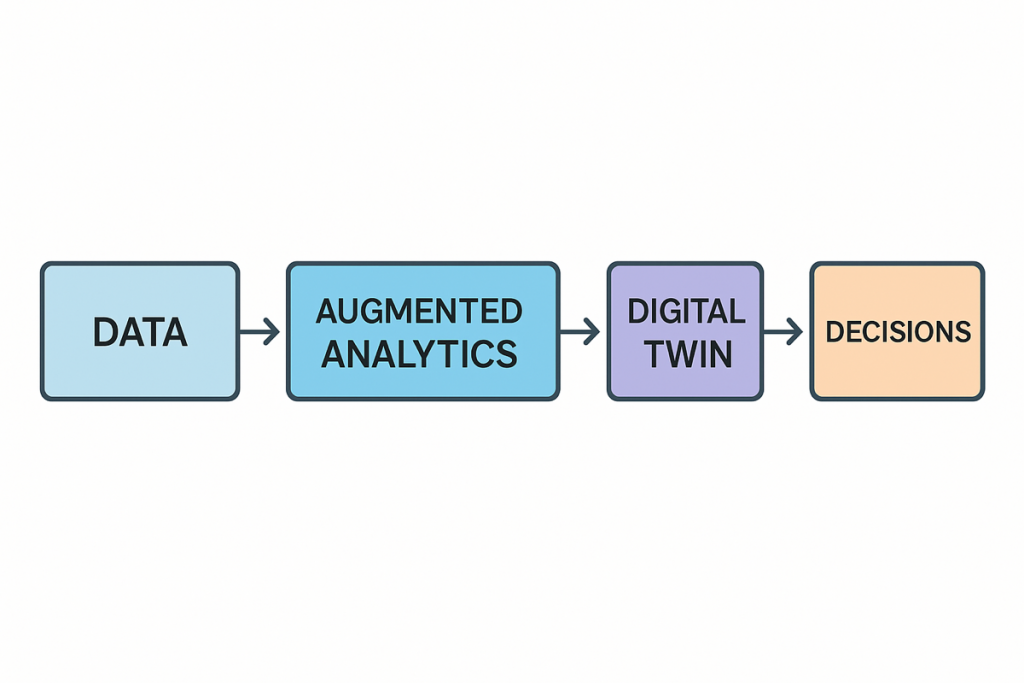
Why Enterprises Need Augmented Analytics Now
1. Fragmented data is a strategic risk
Most companies operate across siloed systems: HR platforms, finance databases, operational tools, IoT sensors, spreadsheets. These silos hide insights and slow decisions.
Augmented analytics unifies these sources and builds a holistic picture of how the organisation truly behaves.
2. Businesses have outgrown human-only reasoning
Modern enterprises are interconnected, fast-moving, and influenced by hundreds of variables. Humans alone can’t track:
- nonlinear relationships
- delayed cause-and-effect
- dynamic market conditions
- operational ripple effects
AI excels at identifying hidden patterns and interactions.
3. Regulation demands transparency
With the EU AI Act and sector-specific regulations emerging, explainability and governance are becoming business-critical.
Augmented analytics naturally supports:
- traceability
- model documentation
- interpretable insights
- robust audit trails
Trust is no longer optional — it’s competitive advantage.
Real-World Use Cases Across Industries
Predictive Maintenance
Manufacturers and utilities use augmented analytics + sensor data to:
- forecast equipment failures
- reduce downtime
- optimise spare parts and labour planning
Financial Risk & Forecasting
Banks and asset managers apply it to:
- credit and liquidity risk
- stress testing
- fraud detection
- scenario modelling
Supply Chain Digital Twins
Retailers and logistics teams simulate:
- disruptions (weather, strikes, supplier issues)
- inventory optimisation
- routing decisions
- demand surges
Healthcare Operations
Hospitals benefit through:
- patient flow forecasting
- resource allocation
- staff scheduling
- capacity planning
Energy & Utilities
Applications include:
- grid balancing
- consumption forecasting
- renewable integration
- pipeline and well-site monitoring
Across all these sectors, the pattern is the same:
With augmented analytics, enterprises shift from reacting to events → to predicting them → to simulating them.
How to Build an Augmented Analytics Capability
1. Establish strong data foundations
- Data cleaning
- Metadata
- Lineage
- Clear governance structures
2. Create a unified data layer
Bring together structured, unstructured, and streaming data using modern architectures like:
- data lakes
- data fabrics
- API layers
- message buses
3. Implement a robust machine learning layer
Depending on the business, this may include:
- predictive models
- reinforcement learning
- forecasting engines
- NLP models
- anomaly detection
4. Combine AI with human-in-the-loop oversight
- Analysts validate outputs
- Domain experts refine assumptions
- Continuous monitoring detects model drift
- Leaders run simulations before acting
This creates a self-improving system: a digital twin that becomes smarter over time.
The Strategic Advantage: From Insight to Foresight
Enterprises that adopt augmented analytics early unlock:
- Faster decision cycles
- Reduced operational risk
- Better forecasting accuracy
- Higher resilience under uncertainty
- More efficient resource allocation
- Competitive differentiation
Most importantly, they evolve from being data-rich but insight-poor — to organisations that anticipate, simulate, and act with precision.
Conclusion — Your Digital Twin Starts with Your Data
Augmented analytics is not just another layer of technology. It’s a new way of thinking about how organisations operate, learn, and evolve.
The companies that invest now will gain an intelligence advantage that compounds over time — and build digital twins that reshape how decisions are made.
The next generation of enterprise performance won’t come from dashboards.
It will come from living models that understand your business as deeply as you do.